

Wisdom Tooth Extraction
Even complex wisdom teeth are extracted safely by our oral surgery specialist.
ABOUT WISDOM TOOTH
What is a Wisdom Tooth?
Wisdom teeth typically emerge between the ages of 17 and 25 as the last molars at the back of the upper and lower jaws. In most cases, lack of space prevents them from erupting properly, causing them to become impacted in the gum or grow at an angle, leading to problems.
Wisdom teeth involve complex variables including position, angle, and proximity to nerves. For impacted wisdom teeth, those near nerves, or those firmly adhered, the judgment of an oral and maxillofacial surgery specialist with extensive experience is essential.
WISDOM TOOTH EXTRACTION
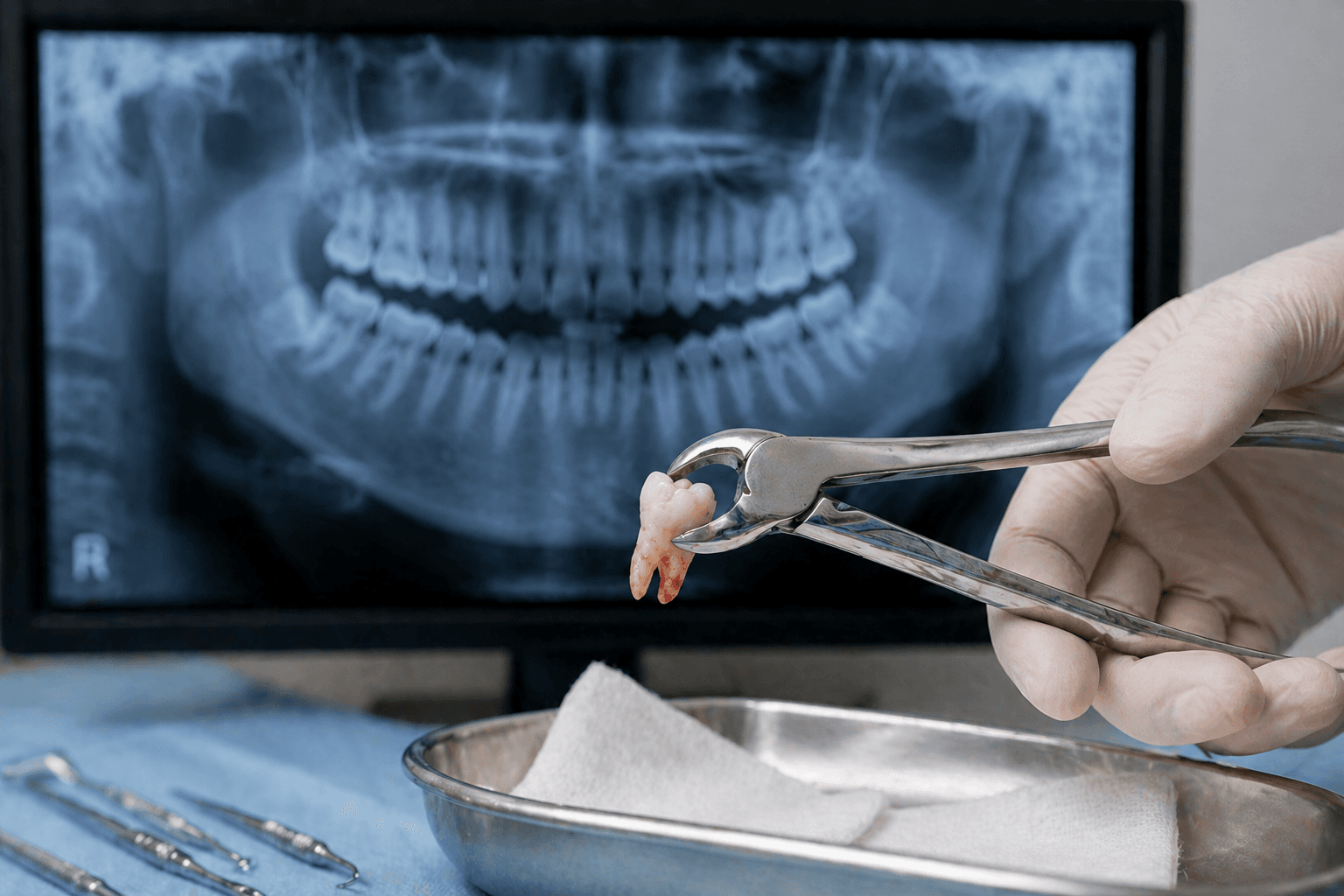
Wisdom Tooth Extraction—We never begin without CT analysis
Impacted wisdom teeth are often located near nerves and blood vessels. We first assess the 3D structure with cone-beam CT, then our oral and maxillofacial surgery specialist safely performs the extraction.
INDICATION
When is wisdom tooth extraction necessary?
What matters most is the impact on surrounding teeth and tissue, not the wisdom tooth itself.
Tooth Decay
When decay causes pain that spreads to adjacent molars
Gum Inflammation
When inflammation in adjacent gum tissue repeatedly causes swelling and pain
Malocclusion
When the wisdom tooth pushes surrounding teeth and affects the bite
Jaw Pain
When a cyst or tumor forms inside the wisdom tooth causing jaw pain
TYPES
Types of Impacted Wisdom Teeth
The difficulty and surgical method differ depending on the type.
Partially Impacted
The tooth is unable to emerge and is only covered by gum tissue. The gum is incised to secure visibility before extraction.
Complex Impaction
The wisdom tooth lies sideways or is positioned near nerves and blood vessels. The safe extraction route is confirmed via CT analysis before proceeding.
Fully Impacted
The tooth is completely buried beneath bone and gum with no visible portion. Partial bone removal and tooth sectioning are required. CT analysis is essential.
PROCEDURE
Wisdom Tooth Extraction Procedure
STEP 01
Cone-Beam CT Scan
The position of the wisdom tooth, nerves, and blood vessels is mapped in 3D to establish a precise surgical plan.
STEP 02
Anesthesia
The procedure begins pain-free with local anesthesia. Sedation can be combined for patients with severe anxiety.
STEP 03
Extraction
Depending on the impaction type, an oral and maxillofacial surgery specialist performs the extraction using incision, bone removal, or tooth sectioning.
STEP 04
Suturing & Post-Op Instructions
After extraction, the wound is sutured and instructions for hemostasis, swelling, and pain management are provided. Sutures are removed after 7 days.
AFTERCARE
Post-Extraction Care
No Smoking or Alcohol on the Day
Smoking and alcohol impair blood circulation, delay clotting, and increase the risk of dry socket (alveolar osteitis).
Soft Foods for 3 Days
Consume liquid or soft foods to avoid irritating the extraction site.
Ice Pack for Severe Swelling
Applying a cold compress at 10-minute intervals on the day of and the day after extraction is effective for reducing swelling and pain.
No Strenuous Exercise Until Sutures Removed
Elevated blood pressure can cause re-bleeding. Limit activities to light movement during the suturing period.